A BOOK EXCERPT
The passion of the Brazilian and Italian fans, and how Parreira coped with the media

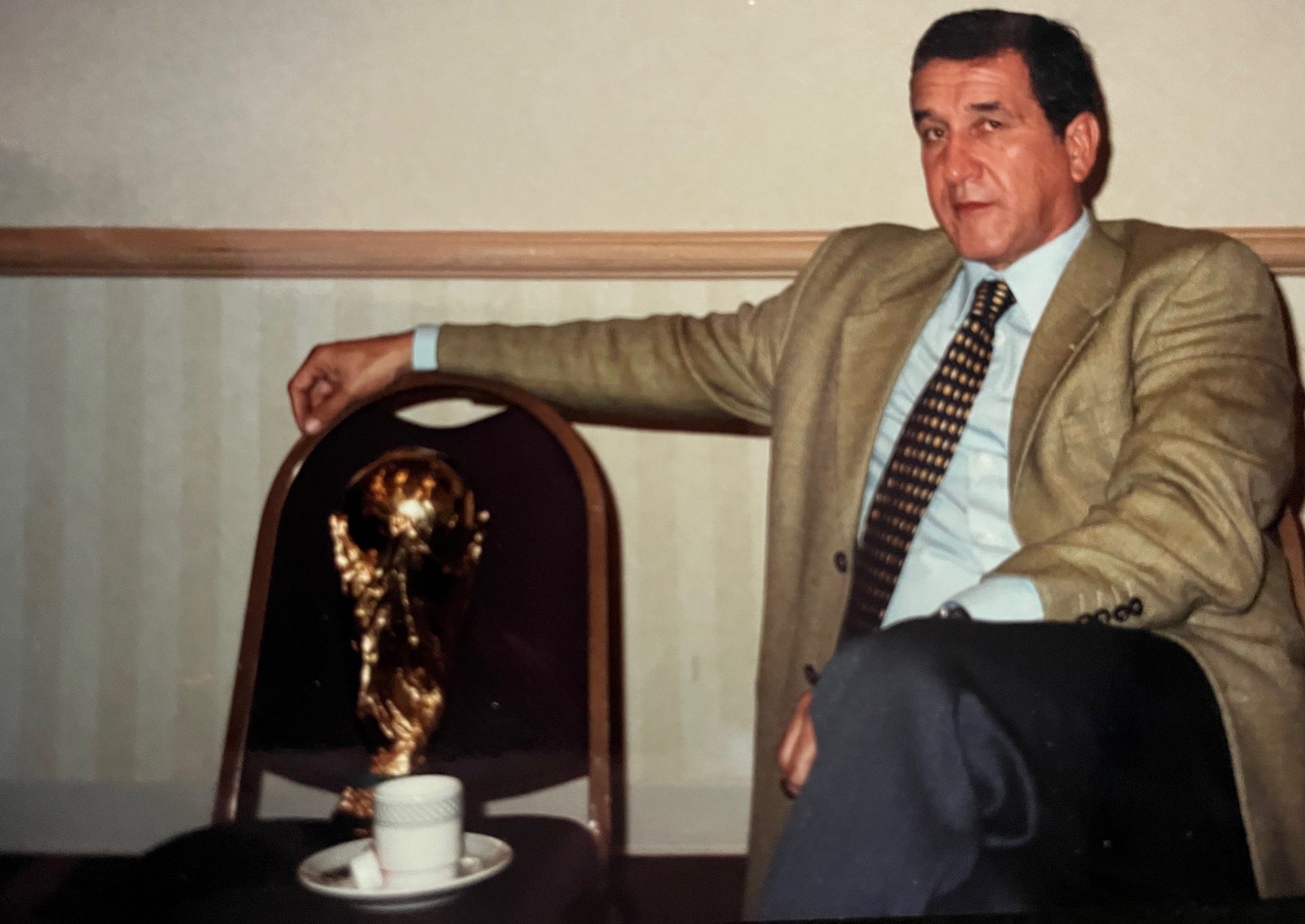
Carlos Alberto Parreira, a reception, sitting next to the World Cup trophy, with a coffee cup next to it. (Michael Lewis Photo)
With the start of the World Cup only days away, FrontRowSoccer.com editor Michael Lewis is sharing two parts of a chapter of his new book, Around the World Cup in 40 Years, An American sportswriter’s perspective.
This is Chapter 2 of the book, which is in two parts, one about the 1994 final and the other about the Brazil press, which was not satisfied with the play of its national team, even though it was a victory away from winning its first World Cup in 24 years, .
Both parts are used with permission of the New York Daily News.
Chapter 2
Fanfare is out of this world
New York Daily News
July 15, 1994
Here are two stories that I wrote for the New York Daily News. They give the reader a feel what this tournament meant for Brazil and Italy in 1994. The second story is about how harsh the Brazilian media was on head coach Carlos Alberto Parreira at the time, even though the team would go on to win its first World Cup in 24 years.
PASADENA, Calif. - Sometimes life is fair. Sometimes we get what we deserve, even in soccer.
On Sunday, Brazil plays Italy for the right to parade around with and kiss the FIFA World Cup trophy, and earn automatic qualification for Franc4e ‘98. All in all, it is a fitting championship game and exclamation point to a glorious World Cup, not just for soccer fans and the sport, but also as a reward for the patience and passion in the countries of the two finalists.
No other two countries in the world deserve to play for the world championship.
Soccer - futbol in Brazil, calcio in Italy - is not just another sport, but something that has evolved almost beyond religion. Soccer is a way of life in both countries, and the World Cup has become life and death.
Literally.
When the Brazilian national team wins, fans die in celebration. When the Brazilian national team loses, fans die of heart attacks.
When Italy was eliminated by Argentina in the semifinals four years ago, perhaps a Rome cab driver said it best: “The World Cup is over.”
But soccer goes on and on.
On basketball courts in Rio de Janeiro, there are also soccer goals, just in case players want to play a mini game.
In impoverished Brazilian neighborhoods, children will kick around bundled-up newspapers, not unlike the way Pele and his contemporaries did to refine their skills so many years ago.
In Rio, there is a monument to soccer built for the 1950 World Cup - Maracanã Stadium, the world’s largest, which originally held 200,000 people, give or take a couple of thousand (it has been cut back to 135,000 for safety reasons).
Once, after a tough loss to a rival, fans of Flamengo burned the flag of their team inside the stadium.
Vasco da Gama, one of Flamengo’s archrivals, has a trophy room with enough silver and other precious metals under glass to wipe out a national debt or two.
Not surprisingly, the media reflects the intense fan interest.
Reporters for newspapers and sports dailies - Italy has three - will not just ask questions of coaches Carlos Alberto Parreira of Brazil and Arrigo Sacchi of Italy, they will debate their player selections, personnel moves, and strategy.
When he played for Napoli, Diego Maradona’s moves on and off the field, and opinions were chronicled, with stories and photos in La Gazzetta dello Sport, on a daily basis. He wasn’t alone. Gazzetta publishes page after page about calcio, and its World Cup coverage, not surprisingly, has runneth over.
After all, Serie A, the Italian First Division, is considered the best soccer league in the world; the planet’s top players perform there every Sunday, and it deserves the best coverage.
Of course, all that media attention might seem tame compared with what transpires in Brazil. Minutes before the kickoff of First Division matches, radio reporters will run onto the field and talk to players for their latest words of wisdom.
Supporters of both countries have waited long for their heroes to win. Brazil hasn’t won a World Cup in 24 years. Italy last won in 1982, which broke a 34-year drought.
Come Sunday, one team will take a victory lap around the Rose Bowl with the FIFA World Cup trophy, not unlike the trip the Rangers took around the rink at the Garden a month ago.
The other team will sit stunned on the field, holding back tears.
One country’s fans will celebrate into the night; the other’s will mourn while their hearts break.
More importantly, the passion of their supporters will be rewarded - finally.
This story is used with permission of the New York Daily News.
Brazilian media press the issue
New York Daily News
July 15, 1994
FULLERTON, Calif. - Every Sunday, O Globo, the most popular TV station in Brazil, has a program that asks fans what they would do if they coached the national team.
A couple of weeks ago, the question was put to the mother of Brazilian coach Carlos Alberto Parreira, and she said she wanted Ronaldo, a 17-year-old with virtually no international experience, to start.
Several hours after Brazil polished off Sweden on Wednesday night to reach its first World Cup final in 24 years, several Brazilian journalists, print and electronic, were calling for the head of Parreira, saying the team and players were no good.
What is going on here?
The undefeated Brazilian national team, which can make some serious history with an unprecedented fourth World Cup championship if it defeats Italy on Sunday, is still under severe criticism - from its own people.
“The Brazil people and press are very demanding and irritating,” said Fabiola Mendes Villela, a Brazilian radio commentator. “The press says second place is last place.”
The Brazilian media is never satisfied; always probing. Why did you pass Bebeto the ball? Why didn’t you pass Bebeto the ball? What did you have for breakfast? Are you talking to Romario? When did you last have sex?
You get the picture.
The scene at Cal State-Fullerton soccer stadium yesterday was business as usual for the media circus, which reportedly numbers about 500. It watched the team practice free kicks for about an hour, and had to settle for interviews with the scrubs, and a short talk - and debate - with Parreira.
Nelson Borges, the team’s beleaguered public relations direction, tried to have some semblance of order, having TV, radio, and then sportswriters do interviews. But there was chaos, as usual. One sportswriter barked in protest that the print media was being treated like dogs.
“They [the media] don’t like the coach,” Villela said. “They think he is stubborn, sticking with some players and not playing others.”
Soccer is so vital to the Brazilians’ state of mind these days, with inflation rampant, and a major distrust and confusion in politics, and with a national election in October.
“Everything is getting worse, the inflation and the politics,” Villela said. “It’s [winning the World Cup] is the only thing they [the people] can be proud of- the Brazilians showing the world they can do things.”
Parreira, who has been around the World Cup and then some, directing Kuwait in the 1982 tournament and the United Arab Emirates at Italia ‘90, realized that the coach of Brazil needs a thick skin.
“This is my fifth World Cup,” he said. “I don’t need to listen to them.”
Both Parriera and Italian coach Arrigo Sacchi have borne the brunt of the most severe criticism.
“It is difficult to bring anything new,” Parreira said. “When passion enters the arena, it even becomes more difficult. The important thing for Sacchi and myself to believe in what we’re doing.”
But Parreira admitted that directing the fortunes of Brazil isn’t that glamorous.
“There is no fun,” he said.
This story is used with permission from the New York Daily News.
You can purchase the book at Amazon.
You can purchase the book here: